
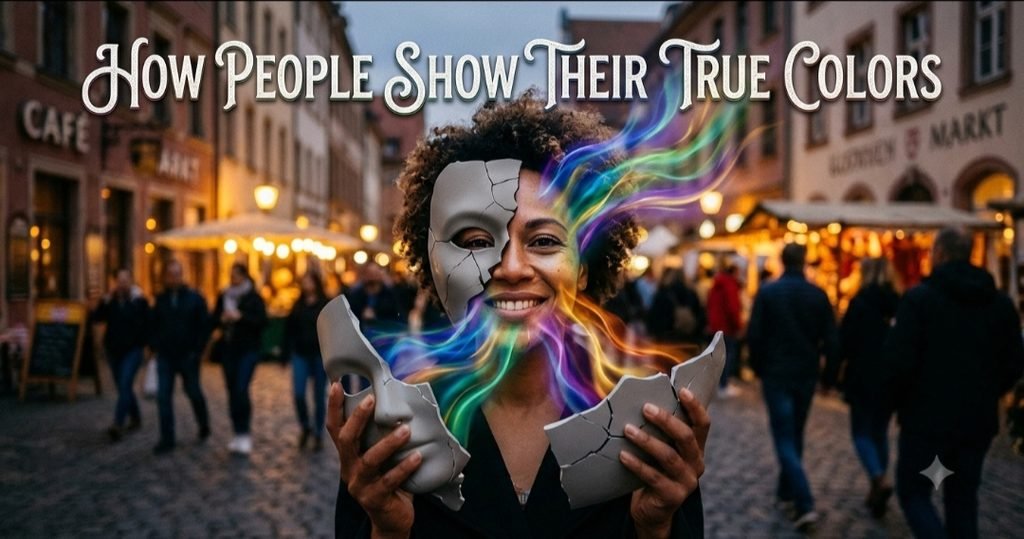
We have all experienced the jarring realization that some people or someone we thought we knew, a trusted friend, a supportive colleague, or a charming partner, is entirely different from the persona they initially presented.
In psychology, the phrase “showing your true colors” refers to the moment a person’s carefully curated social mask slips. It reveals their underlying character, core values, and default emotional responses. But how and when do these revelations happen? People rarely unveil their true selves during calm, predictable routines. Instead, true colors emerge under specific catalysts that test human endurance, ego, and empathy.
1. Under Pressure: The Collapse of the Filter
When life runs smoothly, politeness is cheap. It takes very little effort to be kind, cooperative, and patient when you are well-rested, financially secure, and facing no immediate threats.
However, human cognition has a limited bandwidth for self-regulation. When stress, crisis, or extreme pressure hits, the prefrontal cortex, the area of the brain responsible for impulse control, long-term planning, and social filtering, becomes overwhelmed.
- The Fight-or-Flight Response: Under intense duress, survival instincts override social etiquette.
- The Slip: Someone who is normally mild-mannered may snap, resort to manipulation, or throw others under the bus when a high-stakes project fails or a crisis strikes. Their reaction exposes how they handle fear and powerlessness.
2. In Power and Anonymity: The Revealing Mirror
“If you want to test a man’s character, give him power.”
How a person treats those they perceive as having less power than them is one of the most reliable barometers of character.
- The Service Industry Test: Watch how someone treats a waiter, a parking attendant, or a customer service representative when things go wrong. When there are no social rewards to be gained and no authority figures watching, people show whether their baseline is rooted in fundamental respect or conditional courtesy.
- The Shield of Anonymity: Online behavior offers a similar window. Anonymity strips away immediate social consequences, revealing whether someone’s empathy is authentic or merely a performance driven by reputation management.
3. During Conflict and Disagreement
It is easy to agree with someone when interests align. True colors appear at the exact intersection of diverging interests.
Pay close attention to how someone handles a disagreement when:
- They realize they are wrong.
- They do not get their way.
- You establish a firm boundary that inconveniences them.
Character is defined not by how someone treats you when you are useful to them, but by how they treat you when you are no longer serving their immediate goals or when you challenge their perspective. Do they engage with curiosity and respect, or do they pivot to defensiveness, gaslighting, and character assassination?
4. In the Wake of Someone Else’s Success
Envy is a quiet, corrosive emotion, and how people react to the good fortune of others often exposes deep-seated insecurities and core resentments.
- Conditional Support: False friends celebrate your wins only as long as those wins keep you safely below or equal to them.
- The True Ally: When you achieve a major milestone, watch who leans in with genuine, unprompted enthusiasm versus who distances themselves, minimizes your accomplishment, or responds with backhanded compliments.
Reading Between the Lines
People rarely show their true colors all at once. Instead, character leaks out in micro-behaviors over time. Inconsistencies between words and actions, a pattern of broken small promises, or persistent lack of accountability when things go wrong.
Recognizing these moments isn’t about becoming cynical, it is about paying attention. When someone shows you who they are through their actions under pressure, in power, or during conflict, trust the revelation. It saves you from spending emotional energy on a facade.